In Contrast to the Rigidity Seen in Egyptian Art Minoan Art Focuses on
The Minoan civilization flourished in the Centre Statuary Age (c. 2000 - c. 1500 BCE) on the island of Crete located in the eastern Mediterranean. With their unique fine art and compages, and the spread of their ideas through contact with other cultures beyond the Aegean, the Minoans made a significant contribution to the development of Western European civilization.
Labyrinth-similar palace complexes, vivid frescoes depicting scenes such equally bull-leaping and processions, fine golden jewellery, elegant rock vases, and pottery with vibrant decorations of marine life are all item features of Minoan Crete.
Arthur Evans & Discovery
The archeologist Sir Arthur Evans was first alerted to the possible presence of an ancient civilization on Crete by surviving carved seal stones worn as charms by native Cretans in the early 20th century CE. Excavating at Knossos from 1900 to 1905 CE, Evans discovered all-encompassing ruins which confirmed the ancient accounts, both literary and mythological, of a sophisticated Cretan culture and possible site of the legendary labyrinth and palace of King Minos. It was Evans who coined the term Minoan in reference to this legendary Bronze Age king. Evans, seeing what he believed to be the growth and decline of a unified civilisation on Crete, divided the isle'southward Bronze Age into three distinct phases largely based on different pottery styles:
- Early Bronze Historic period or Early Minoan (EM): 3000-2100 BCE
- Middle Statuary Age or Centre Minoan (MM): 2100-1600 BCE
- Late Bronze Age or Tardily Minoan (LM): 1600-1100 BCE
The above divisions were subsequently refined by adding numbered subphases to each group (due east.g. MM II). Radio-carbon dating and tree-ring calibration techniques have helped to farther refine the dates so that the Early on Statuary Age now begins c. 3500 BCE and the Late Statuary Age c. 1700 BCE. An alternative to this series of divisions, created past Platon, instead focuses on the events occurring in and around the major Minoan "palaces". This scheme has four periods:
- Prepalatial: 3000 - 2000/1900 BCE
- Protopalatial: 2000/1900 - 1700 BCE
- Neopalatial: 1700 - 1470/1450 BCE
- Postpalatial: 1470/1450 - 1100 BCE
Both of these schemes have since been challenged by more modern archæology and approaches to history and anthropology in general which prefer a more multilinear development of civilization on Crete with a more circuitous scenario involving conflicts and inequalities between settlements and which also considers their cultural differences as well equally their obvious similarities.
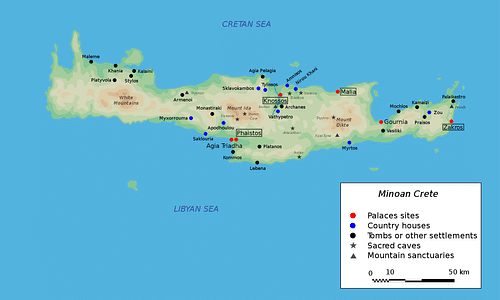
Map of Minoan Crete
Minoan Palace Settlements
Minoan settlements, tombs, and cemeteries accept been found all over Crete but the four primary palace sites (in order of size) were:
- Knossos
- Phaistos
- Malia
- Zakros
Minoan palaces exerted some kind of localised control, in particular, in the gathering & storage of surplus materials.
At each of these sites, big, complex palace structures seem to have acted as local administrative, trade, religious, and possibly political centres. The relationship between the palaces and the power structure within them or over the island as a whole is non articulate due to a lack of archaeological and literary evidence. It is articulate, still, that the palaces exerted some kind of localised control, in particular, in the gathering and storage of surplus materials - wine, oil, grain, precious metals and ceramics. Small towns, villages, and farms were spread effectually the territory seemingly controlled by a single palace. Roads connected these isolated settlements to each other and the main centre. There is a general agreement among historians that the palaces were independent from each other up to 1700 BCE, and thereafter they came under the sway of Knossos, equally evidenced by a greater uniformity in architecture and the utilize of Linear A writing across various palace sites.
The absence of fortifications in the settlements suggests a relatively peaceful co-beingness between the different communities. However, the presence of weapons such as swords, daggers, and arrowheads, and defensive equipment such as armour and helmets would also propose that peace may not ever take been enjoyed. Minoan roads, besides, have evidence of regular guardhouses and watchtowers suggesting that banditry, at least, troubled the unprotected traveller.
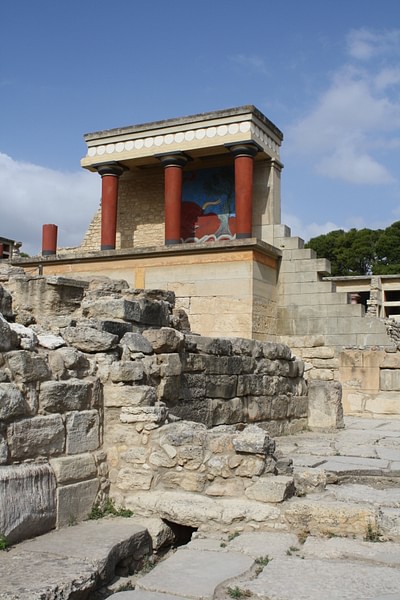
Palace of Knossos
The palaces themselves covered two periods. The commencement palaces were constructed around 2000 BCE and, following destructive earthquakes and fires, rebuilt again c. 1700 BCE. These second palaces survived until their final destruction between 1500 BCE and 1450 BCE, once again past either earthquake, burn, or possibly invasion (or a combination of all three). The palaces were well-appointed, monumental structures with large courts, colonnades, ceilings supported by tapered wooden columns, staircases, religious crypts, light-wells, extensive drainage systems, big storage magazines and fifty-fifty 'theatre' areas for public glasses or religious processions.
Depictions of double axes (or labrys) & the complex palaces may have combined to give birth to the legend of Theseus & the labyrinth-dwelling Minotaur.
Reaching upward to 4 stories high and spreading over several thousand square metres, the complication of these palaces, the sport of balderdash-leaping, the worship of bulls as indicated by the presence throughout of sacred bulls' horns and depictions of double axes (or labrys) in rock and fresco may all have combined to give birth to the legend of Theseus and the labyrinth-dwelling Minotaur so popular in later classical Greek mythology.
Religion
The religion of the Minoans remains sketchy, but details are revealed through art, architecture, and artefacts. These include depictions of religious ceremonies and rituals such as the pouring of libations, making food offerings, processions, feasts, and sporting events like balderdash-leaping. Natural forces and nature in full general, manifested in such artworks equally a voluptuous female mother-earth goddess figure and male figure holding several animals, seem to accept been revered. Palaces contain open up courtyards for mass gatherings and rooms often take wells and channels for the pouring of libations, equally previously noted. Every bit already mentioned, too, bulls are prominent in Minoan art, and their horns are an architectural feature of palace walls and a general decorative element in jewellery, frescoes, and pottery decoration. Dramatic rural sites such as hilltops and caves often show testify of cult rituals being performed there.
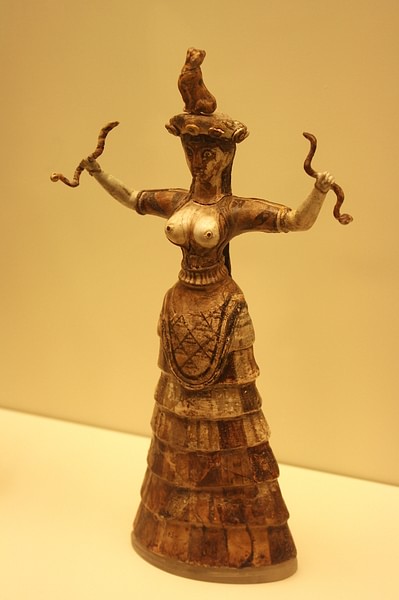
Minoan Ophidian Goddess, Knossos.
Cloth Culture
The sophistication of the Minoan culture and its trading capacity is evidenced by the presence of writing, firstly Cretan Hieroglyphic (c. 2000-1700 BCE) and then Linear A scripts (both, as yet, undeciphered), predominantly establish on various types of authoritative clay tablets. Seal impressions on clay were some other important form of record keeping.
A further case of the civilization'south high caste of development is the diversity and quality of the art forms practised by the Minoans. Pottery finds reveal a broad range of vessels from wafer-thin cups to large storage jars (pithoi). Ceramics were initially hand-turned but then increasingly made on the potter'due south wheel. In ornament, at that place was a progression from flowing geometric designs in Kamares ware to vibrant naturalistic depictions of flowers, plants, and sea life in the afterwards Floral and Marine styles. Common pottery shapes include three-handled amphorae, tall beaked-jugs, squat round vessels with a false spout, beakers, small lidded boxes, and ritual vessels with effigy-of-viii-shaped handles. Stone was also used to produce similar vessel types and rhyta (ritual vessels for pouring libations, often in the shape of animal heads).
Large-scale figure sculpture has not survived merely there are many figurines in bronze and other materials. Early types in clay show the clothes of the time with men (coloured ruddy) wearing belted loincloths and women (coloured white) in long flowing dresses and open-fronted jackets. A leaping acrobat in ivory and the faience snake goddess already mentioned are notable works which reveal the Minoan love of capturing figures in active striking poses.

Minoan Bull Leaping
Magnificent frescoes from the walls, ceilings, and floors of the palaces besides reveal the Minoans' love of the bounding main and nature and give insights into religious, communal, and funeral practices. Subjects range in scale from miniature to larger-than-life size. The Minoans were i of the earliest cultures to paint natural landscapes without any humans present in the scene; such was their admiration of nature. Animals, likewise, were frequently depicted in their natural habitat, for case, monkeys, birds, dolphins, and fish. Although Minoan frescoes were oft framed with decorative borders of geometric designs, the principal fresco itself, on occasion, went beyond conventional boundaries such equally corners and covered several walls of a single room, surrounding the viewer.
Minoan artists, especially fresco painters, took their skills to the regal palaces of Egypt & the Levant.
Aegean Contacts
The Minoans, equally a seafaring culture, were likewise in contact with foreign peoples throughout the Aegean, equally evidenced past the Near Eastern and Egyptian influences in their early art but as well in the later export trade, notably the commutation of pottery and foodstuffs such every bit oil and vino in render for precious objects and materials such as copper from Republic of cyprus and Attica and ivory from Egypt. Several Aegean islands, peculiarly in the Cyclades, brandish the characteristics of a palace-centred economy and political structure every bit seen on Crete while Minoan artists, specially fresco painters, took their skills to the royal palaces of Egypt and the Levant.
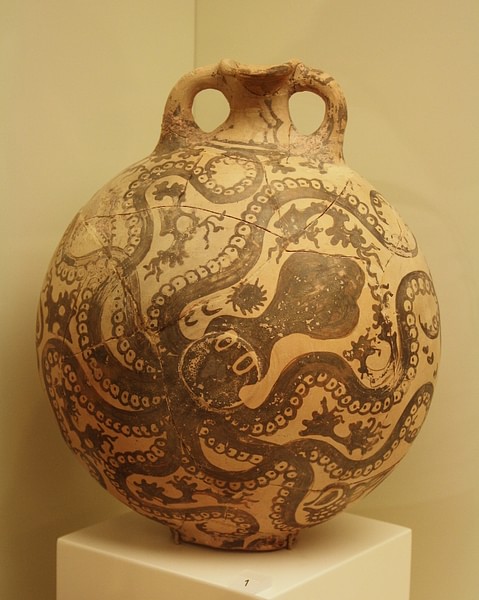
Minoan Vase in Marine Mode
Decline
The reasons for the demise of the Minoan civilization keep to be debated. Palaces and settlements show evidence of fire and destruction c. 1450 BCE, merely non at Knossos (which was destroyed mayhap a century later). The ascent of the Mycenaean civilization in the mid-2d millennium BCE on the Greek mainland and the prove of their cultural influence on afterwards Minoan fine art and trade make them the most likely cause. However, other suggestions include earthquakes and volcanic activity with a consequent tsunami. The eruption of Thera (the nowadays-day island of Santorini) may have been particularly significant, although, the exact date of this cataclysmic eruption is disputed and therefore its connectedness with the end of the Minoan period remains unclear. The most likely scenario was probably a fatal mix of natural environmental damage and competition for wealth weakening the structure of social club, which was then exploited by invading Mycenaeans. Whatever the crusade, most of the Minoan sites were abandoned by 1200 BCE and Crete would non return to the Mediterranean stage of history until the 8th century BCE when it was colonised by Archaic Greeks.
This article has been reviewed for accuracy, reliability and adherence to bookish standards prior to publication.
Source: https://www.worldhistory.org/Minoan_Civilization/
0 Response to "In Contrast to the Rigidity Seen in Egyptian Art Minoan Art Focuses on"
Post a Comment